

💡 What Is Familiarity in Marketing?
Imagine this…
You come up with a new, unique, business concept.
Maybe you open up a shop with a one-of-a-kind customer experience. Or your landing page is made to stand out from all the typical ones. Perhaps your clients need to go through some unusual steps to reach your product.
Whatever it is, it fails miserably.
You get high bounce rates, app uninstalls, churn rate. Your lead gen may shine, but conversion tanks.
Heck, in some cases, you might even have been doing stuff like that without realizing it.
If that’s the case, there’s a high chance you did not take account of the familiarity people need to be buying your offering.
In marketing, familiarity refers to how recognizable, predictable, and cognitively easy your brand, messaging, or user experience feels. The more something aligns with existing habits and expectations, the easier it is for customers to trust it.
🧬 The Psychology and Biology Behind Familiarity
We are habitual creatures.
People love making habits, using routines, having familiarity with what’s around them.
Not having it generates anxiety and repulsiveness.
Coming up to something that’s unfamiliar unconsciously heightens our awareness and stress levels.
This is not the norm, but it’s more common than you think.
From a neuroscience perspective, familiar patterns require less mental energy to process. That’s why people gravitate toward brands, layouts, and experiences that feel predictable.
In marketing, this is often called the mere exposure effect — the tendency to develop preference for things simply because we’ve seen them before.
🦆 Case Study: When Familiar UX Patterns Are Broken
Let me give you an example.
I tried using the DuckDuckGo browser for my laptop (I already have it on my phone).
But DuckDuckGo browser for PC left me stumped, feeling like a duck out of water.
Bear in mind some my PC-related habits formed after years of using the PC.
Habit 1: (maybe you’ll relate). Apps on my laptop open in a matter of ~1-2 secs. DuckDuckGo browser opens in like 5-10 secs on first run. Weird.
Habit 2: I use middle mouse click a lot. In both Chrome and Firefox, clicking it in the address bar (on a typed website link) opens a new tab. Not in DuckDuckGo, where it overrides the existing tab. Middle-clicking the Go back one page (Left arrow in top left corner) should also create a new tab. Well, not in DuckDuckGo.
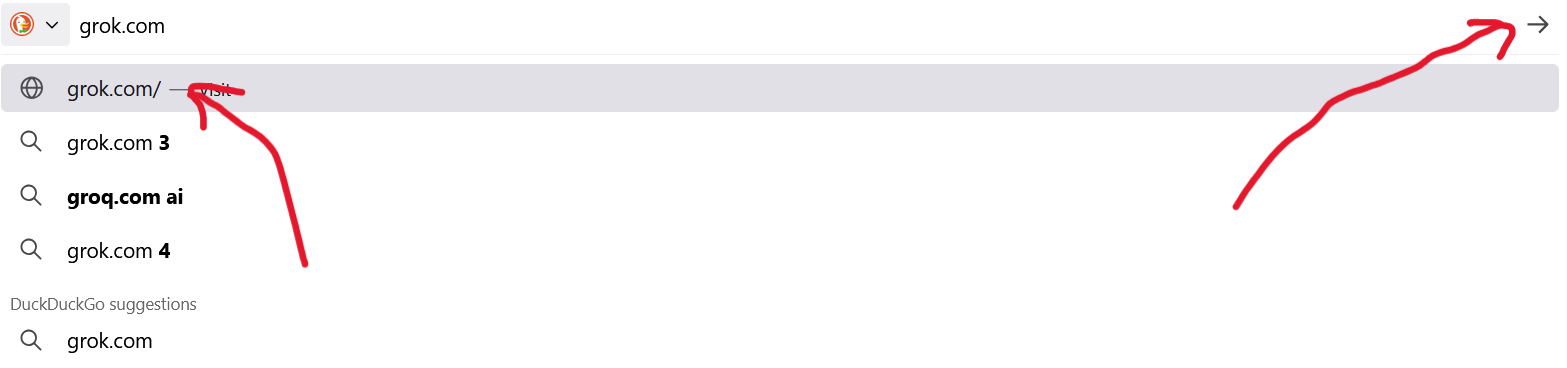
Habit 3: When using my laptop, my left hand naturally sits on the left part of the keyboard, while my right hand is on the mouse. The trackpad is disabled. In Firefox, when I type something in the address bar, a drop-down list comes, well, down. Plus, there’s an arrow one can click to go directly to the site. Like this:
Firefox: Choose your way
Let’s check in on DuckDuckGo and how it messes everything up.
Firstly, the drop-down list is not shown anymore if one clicks outside the address bar. You have to type something for it to appear.
Secondly, that lil’ arrow button is completely missing, so using the mouse gets you nowhere. You can’t click on the address to access it.
I’m guessing the only shot is to press “Enter,” which, for me, is out of reach while I use the mouse. (TBH, I see Chrome does the same thing.)

DuckDuckGo: Erm, now what?
🎯 When Does Disruption Actually Work in Marketing?
While familiarity is powerful, strategic disruption can work under specific conditions:
➡️ You sell something that’s meant to disrupt the habits (e.g. you’re a pioneer and people should expect unfamiliarity). In this case, you may consider making it easier for your customers to get acquainted to it (through tutorials, knowledge base articles, videos).
➡️You sell to people who love out-of-the-ordinary situations (e.g. you’re in the extreme sports niche, where people would love something different, they’re here for the thrill).
➡️Your brand positioning is so good that you can afford to be seen as more different that your competitors (maybe you’re Apple and your users expect some kind of extraordinary experience).
The best marketing balances familiarity with just enough novelty to stay interesting — without overwhelming your audience.
TLDR: Make sure you don’t annoy your customers TOO MUCH, or they’ll leave you quite easily.